


What Happens During an EMDR Session? Here's What to Expect Before You Start
If you're considering EMDR therapy but aren't quite sure what happens during an EMDR session, you're probably wondering what you'll actually be doing, whether you'll have to talk about your trauma, and how intense the experience might feel. At MK Wellness Collective, based in Tyngsborough, Massachusetts, we offer virtual EMDR therapy to help adults work through distressing experiences, trauma, and patterns that continue affecting their everyday lives.
And no, your therapist isn't going to ask you to unpack your most painful memories five minutes after meeting you. There's a process, and understanding it can make starting feel a whole lot less intimidating.
What Actually Happens During an EMDR Session?
EMDR stands for Eye Movement Desensitization and Reprocessing. It's an evidence-based psychotherapy approach used to treat trauma and PTSD, and it may also be helpful for other concerns when distressing experiences contribute to current symptoms.
During EMDR therapy, your therapist helps you identify experiences, memories, and beliefs that continue causing distress. When you're ready for the processing phase, you'll briefly focus on aspects of a memory while engaging in bilateral stimulation, which involves alternating attention from one side to the other.
That might involve following a moving visual target with your eyes or using alternating tapping, depending on your therapist's approach and what works best for you.
The goal is to help you process distressing memories so they become less emotionally overwhelming and have less influence over how you respond in the present.
You aren't being hypnotized. You're awake, aware, and able to communicate with your therapist throughout the process.
Will I Have to Talk About My Trauma During My First EMDR Session?
No. You generally won't jump straight into processing traumatic memories during your first EMDR session.
EMDR follows an eight-phase treatment approach, and the early phases focus on understanding your history, identifying treatment goals, building coping strategies, and making sure you're prepared for memory processing.
Your therapist will want to understand what's bringing you to therapy, what you've been experiencing, and how those experiences are affecting your life.
Maybe you constantly anticipate something going wrong, struggle to trust yourself, or feel an intense need to keep everyone around you happy.
Maybe you know exactly why certain situations upset you, but understanding the connection hasn't made those reactions any easier to manage.
Your therapist will work with you to identify patterns and determine whether EMDR is appropriate for your needs.
You also don't have to share every detail of a traumatic experience to participate in EMDR. Your therapist needs enough information to guide treatment safely, but EMDR doesn't require repeatedly describing every painful moment out loud.
What Are the Different Stages of an EMDR Therapy Session?
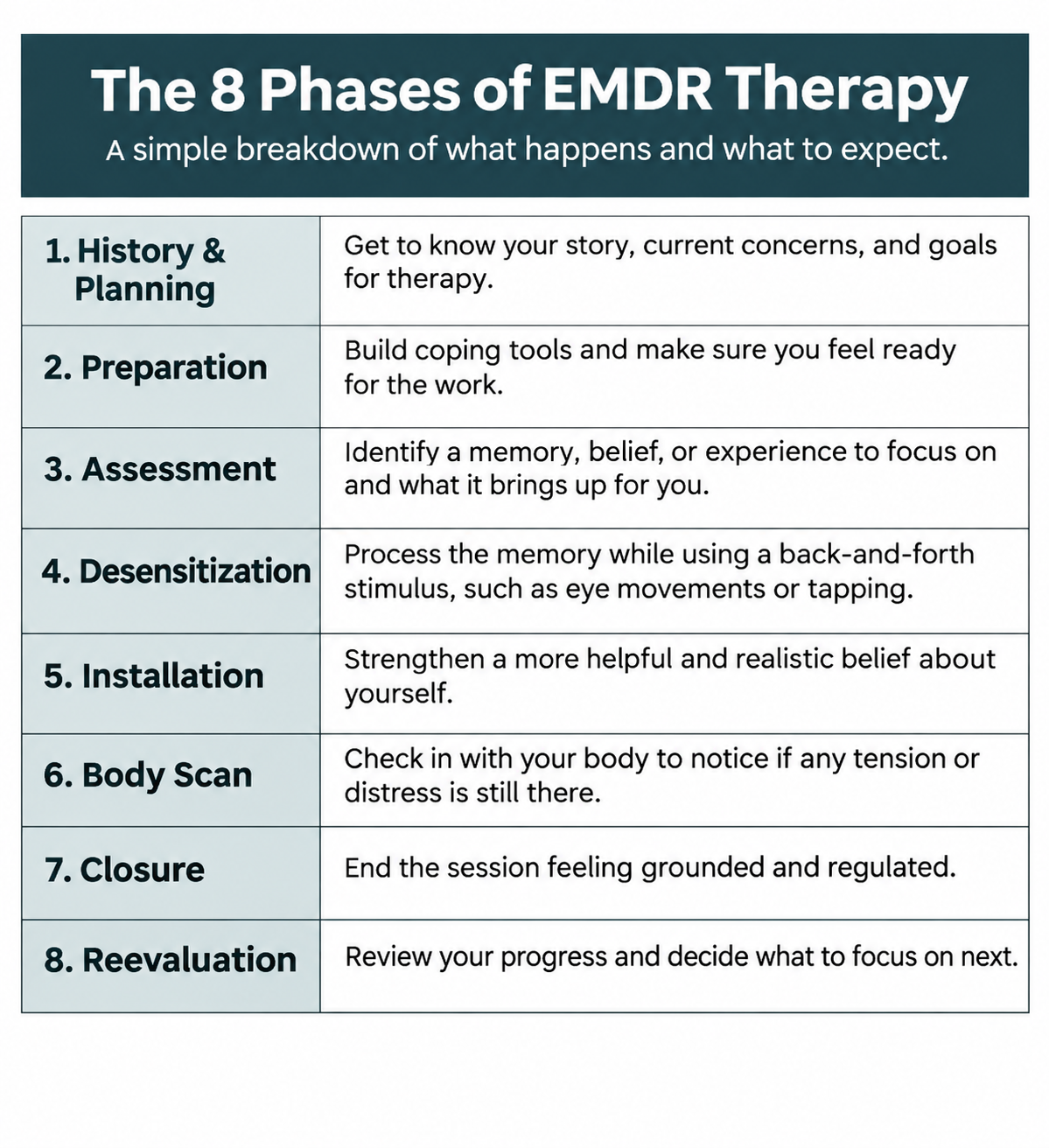
EMDR therapy involves eight phases, but they don't necessarily happen in one appointment. Some phases take multiple sessions, and your therapist may return to preparation or stabilization whenever needed.
Here's a simplified look at what the process can involve.
The process is collaborative, and your therapist adjusts the pace based on your needs.
You don't need to show up knowing how to do EMDR. That's literally what your therapist is there to help you with.
What Does EMDR Feel Like While You're Processing a Memory?
This is usually the part people are most curious about.
During the processing phase, your therapist may ask you to briefly bring a specific memory to mind while noticing a related thought, emotion, or physical sensation.
Then you'll engage in short sets of bilateral stimulation.
Between sets, your therapist may ask what you're noticing. Sometimes a different memory comes up. Sometimes your thoughts shift, an emotion changes, or you notice a physical sensation.
Other times, you might feel like nothing particularly dramatic is happening.
There's no single correct experience.
Some people notice emotional relief or a change in how distressing a memory feels. Others experience sadness, frustration, fatigue, or temporary increases in distress.
You may notice physical sensations such as tension in your shoulders, tightness in your chest, or changes in your breathing.
Your therapist will monitor how you're doing throughout the process and help you stay within a manageable level of distress.
EMDR can bring up difficult emotions, but you should never feel pressured to push through more than you can safely tolerate. You can ask questions, request a pause, or discuss changing the pace.
Can EMDR Help If I Have Anxiety, Perfectionism, or Trouble Relaxing?
EMDR may be helpful when anxiety, perfectionism, or difficulty relaxing are connected to distressing past experiences or learned beliefs about yourself.
Think about the woman who's constantly preparing for the worst.
She's the one checking the calendar three times, replaying conversations, anticipating everyone's needs, and feeling personally responsible when something goes wrong.
From the outside, she looks incredibly organized.
Internally, she's exhausted.
Sometimes these patterns develop through repeated stressful experiences, criticism, unpredictable relationships, or situations where being prepared helped someone feel more secure.
That doesn't automatically mean every high-achieving woman has unresolved trauma. Anxiety and perfectionism can develop for many reasons.
But when past experiences continue influencing how you see yourself, relationships, or safety, EMDR may be worth exploring.
For example, someone who learned early in life that making mistakes led to harsh criticism might carry a persistent belief that they must do everything perfectly.
EMDR may help address the distressing experiences and beliefs contributing to that pattern.
The goal isn't to eliminate ambition or make you care less about your responsibilities. It's to help reduce the emotional distress that may be driving certain reactions.
What Happens After an EMDR Session?
After an EMDR session, your therapist will help you transition out of the processing work and check how you're feeling before the appointment ends.
You might feel tired, emotional, relieved, or relatively unchanged.
Some people notice additional thoughts, dreams, emotions, or memories between appointments. Others don't experience much outside the session.
Your therapist may recommend noticing changes between sessions and using grounding strategies when needed.
It can also help to leave yourself a little breathing room afterward when possible.
And yes, I realize that telling a busy mom to leave space in her schedule can sound borderline ridiculous.
But if you have the flexibility, avoiding an immediate jump into a packed afternoon may give you time to settle after emotionally demanding work.
If you experience distress that feels difficult to manage between appointments, let your therapist know so they can adjust the treatment plan.
Can I Do EMDR Therapy Online in Massachusetts?
Yes. EMDR can be provided virtually when it's clinically appropriate and the therapist has suitable training and a plan for conducting treatment safely online.
At MK Wellness Collective, we offer virtual EMDR therapy in Massachusetts, allowing you to attend appointments from a private, comfortable space.
Emily Burns, LMHC, CCTP, offers trauma-informed EMDR therapy for Massachusetts clients. Her approach also incorporates mindfulness and considers how trauma and stressful experiences can affect emotional well-being.
For some clients, virtual appointments make therapy easier to fit around work, parenting, and other responsibilities.
You won't need to drive to an office, arrange extra travel time, or spend half your afternoon sitting in traffic.
You'll still need a private space, reliable internet, and an environment where you can participate without interruptions.
Your therapist will discuss whether virtual EMDR is an appropriate fit for your circumstances.
Frequently Asked Questions About EMDR Sessions
How long does an EMDR session last?
EMDR sessions vary in length depending on the therapist, treatment plan, and type of appointment. Some are similar in length to traditional therapy sessions, while others are extended to allow more time for preparation, processing, and closure. MK Wellness Collective also offers 90-minute extended EMDR sessions for Massachusetts clients.
How many EMDR sessions will I need?
There's no universal number of EMDR sessions. Treatment length depends on your history, symptoms, goals, readiness, and the complexity of the experiences you're addressing. Some people benefit from a shorter course of treatment, while others need longer-term support.
Do I have to remember everything that happened to benefit from EMDR?
No. EMDR doesn't require a complete or perfectly detailed memory of every experience. Your therapist can help determine appropriate treatment targets based on what you remember and what you're experiencing now. EMDR should not be used to try to recover or verify uncertain memories.
Is it normal to feel emotional after EMDR?
Yes. Some people experience temporary emotional sensitivity, fatigue, or changes in thoughts and dreams following processing sessions. Responses vary, and your therapist should discuss what to expect and how to manage distress between appointments.
Ready to Explore EMDR Therapy in Massachusetts?
If you've spent years overthinking, staying prepared for every possible problem, or feeling like your past still has a say in how you experience the present, EMDR therapy may be worth exploring.
You don't have to know exactly where to start or have all the answers before reaching out.
If you're ready to start digging in and making change, reach out here to book a session with a MKWC licensed therapist.
MK Wellness Collective offers virtual therapy for adults in Massachusetts, including trauma-informed EMDR therapy with Emily Burns, LMHC, CCTP.
Keep Reading
How Do I Know If I Need Trauma Therapy?
Wondering whether past experiences are still affecting your everyday life? Learn what trauma-related patterns can look like and when therapy may help.
Why You Can Understand Your Anxiety and Still Feel It in Your Body
Ever feel like you know exactly why you're anxious, but your body hasn't gotten the memo? Explore why insight alone doesn't always change your physical stress response.
Somatic Therapy vs. Talk Therapy: What's the Difference?
Learn how different therapeutic approaches address stress, trauma, emotions, and the mind-body connection.

Megan Kolb, LICSW, ACSW is the founder of MK Wellness Collective and has worked in the behavioral health field since 2018 helping high-achieving millennial women and moms navigate anxiety, burnout, perfectionism, and the invisible mental load of everyday life.
Using a blend of CBT, mindfulness, somatic therapy, attachment-informed and trauma-informed care, Megan helps clients feel less overwhelmed, regulate their nervous systems, build healthier boundaries, trust themselves more, and become more present in their relationships and daily lives. She specializes in anxiety, high-functioning anxiety, maternal mental health, pregnancy and postpartum concerns, and emotional regulation, and provides online therapy for women and moms throughout Massachusetts and New Hampshire.
